Students develop innovative projects to combat industrial and economic issues
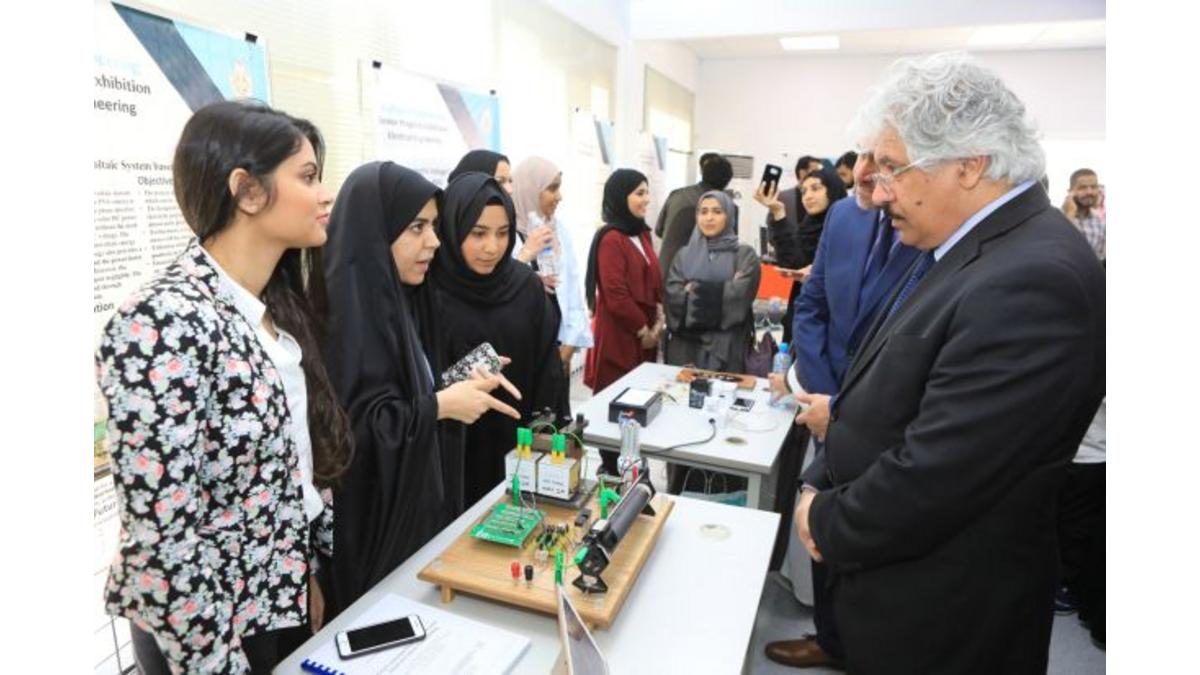
A NUMBER of innovative student projects to combat emerging industrial and economic issues have been developed.
Students enrolled in the college of engineering at Bahrain University have developed 64 projects that provide engineering solutions to pressing social, economic and industrial issues.
The newly-graduated university students presented their projects at the university’s Graduation Projects Exhibition, where six winning projects were announced, including a wave energy production unit, an electronic system to locate electrical faults, and a system that predicts lapses in industrial processes.
The exhibition was opened by university president Dr Riyad Hamza who stressed the importance of evolving the designs into commercial projects for the market.
“I congratulate students and professors alike for their outstanding projects not only in their commitment to engineering standards, calculations and precision equations, but also in their ideas that respond to development needs,” he said. “I urge the students not to hesitate to patent their new projects, and to transform their designs and innovations into commercial ventures that will make their way into the market, which will enable them to become productive entrepreneurs who contribute to the national economy.”
Sara Masaad, Safia Jassim and Laila Mehdi won the top prize in the electronic engineering category for their development of a system that helps people with special needs control their body through brain waves.
“The system we have developed helps individuals who cannot control their body to issue orders through their brain impulses which are processed by an electronic reader,” said Ms Jassim.
She added that the project had an 81 per cent success rate in laboratory trials and, along with her teammates, expressed confidence the system could be further developed and commercialised.
In the electrical engineering category, Osama Abdulrahman, Othman Ghani and Mahmoud Bashir developed an electronic system linked to the Global Navigation Satellite System (GPS), which won first place.
Students of the civil engineering programme, Hadi Abdulhamid, Shahbaz Abed and Rabea Mubarak, won first place in their category for a project that aims to design a building suspended between two hotels.
“We have done more than 23 design processes over the course of two full seasons using specialised design programs, and we have used reinforced concrete, iron and covers to design the tower with high precision,” said Mr Abdulhamid.
Meanwhile, Haneen Abdelkarim, Inas Al Naggar and Alia Galal from the chemical engineering programme developed plans for a factory equipped with sensors that enabled technicians to measure industrial variables such as heat, flow and pressure. In turn, the measurements would allow technicians to predict accidents before they occurred.
In first place for the industrial processes category was Abdulrahman Mohammed, Jaber Ahmed and Bader Nabil for their product that developed gas processing operations of a distillation tower at a gas production factory.
Mr Nabil explained that the unconventional processing of gas would improve the quality of the product and reduce power consumption.
Mohammed Sinan, Abdulla Salami and Issa Yousif won first prize in the mechanical engineering category for developing a unit for the production of energy through wave movement.
“The idea of the project is to take advantage of the wind wave mechanism to generate energy and to create generating stations at sea,” said Mr Salami.
He added that the team invented the mechanism after many experiments and was considering having a patent on the project.